
Artificial intelligence is now everywhere.
Students use it to summarize lectures. Freelancers use it to speed up writing. Businesses automate customer support with it. Teams rely on AI for brainstorming, analytics, scheduling, and workflow automation. The rise of productivity AI tools has been explosive, but so has the confusion around AI vs Human Judgment.
People know AI saves time. What they do not always understand is where AI should stop and where human thinking must take over.
That line matters more than ever in 2026.
A growing number of workers now depend on AI daily, yet surveys show most employees still do not fully trust AI-generated decisions without human oversight. Researchers studying workplace automation have repeatedly found that companies gain productivity from AI initially, but hidden losses appear later when humans must correct inaccurate outputs, fix contextual mistakes, or repair damaged communication. (Microsoft Work Trend Index)
This is why understanding AI vs Human Judgment has become essential for anyone building modern productivity systems.
The smartest people are not choosing between AI or humans.
They are designing workflows where AI accelerates execution while humans guide strategy, ethics, creativity, and critical decisions. That combination creates faster systems without sacrificing quality, trust, or long-term thinking.
If you run a business, manage projects, study online, freelance remotely, or build digital workflows, this guide will help you understand exactly when to trust AI, when to trust human judgment, and how to combine both for maximum productivity.

Why AI Productivity Feels Both Amazing and Dangerous
The reason people struggle with AI vs Human Judgment is simple: AI feels intelligent.
It writes fluently. It answers quickly. It sounds confident. That confidence tricks many users into assuming the output is accurate, thoughtful, or strategically correct. In reality, AI predicts patterns based on massive datasets. It does not truly understand meaning, consequences, ethics, or emotional context the way humans do.
This creates a strange productivity paradox.
AI dramatically speeds up work while simultaneously increasing the possibility of subtle mistakes.
For example, AI can summarize a meeting in seconds. That sounds incredible until the summary misses a sensitive client concern or incorrectly interprets a strategic decision. AI can generate a professional email instantly, but it may accidentally sound robotic or emotionally tone-deaf in a delicate situation.
That is why blindly automating everything rarely works.
Research from workplace productivity studies shows many companies now face “AI correction fatigue,” where employees save time initially but later spend hours reviewing inaccurate or incomplete outputs. (Harvard Business Review)
The problem is not AI itself.
The problem is using AI in situations that require judgment rather than speed.
If you already feel overwhelmed by too many automation tools, read our guide on How to Avoid AI Tool Overload in 2026, where we break down how scattered AI systems quietly reduce productivity instead of improving it.
The Real Difference Between AI and Human Thinking
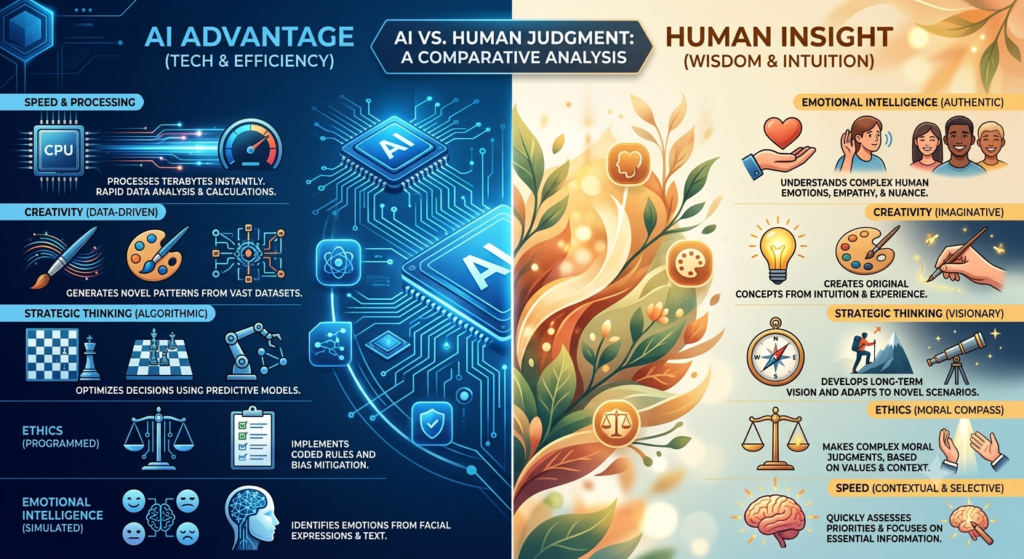
Understanding AI vs Human Judgment starts with recognizing that AI and humans solve problems differently.
What AI Does Better
AI performs exceptionally well when:
- Rules are clear
- Patterns repeat
- Speed matters
- Large datasets exist
- Structure is predictable
AI excels at:
- Summarization
- Categorization
- Draft generation
- Repetitive formatting
- Workflow automation
- Information retrieval
- Predictive pattern analysis
For repetitive digital work, AI is often dramatically faster than humans.
What Humans Still Dominate
Humans still outperform AI in:
- Emotional intelligence
- Ethics
- Strategic thinking
- Cultural awareness
- Creativity with purpose
- Ambiguous decision-making
- Accountability
AI may generate ten marketing slogans quickly, but humans understand which slogan could damage a brand emotionally or socially.
That distinction defines modern productivity.
AI handles acceleration.
Humans handle direction.
AI vs Human Judgment Comparison Table
| Category | AI Strength | Human Strength |
| Speed | Extremely fast | Slower |
| Repetitive Tasks | Excellent | Weak |
| Creativity | Pattern-based | Intentional |
| Ethics | Limited | Strong |
| Emotional Understanding | Weak | Excellent |
| Data Analysis | Outstanding | Moderate |
| Strategic Thinking | Limited context | Superior |
| Accountability | None | Full responsibility |
| Adaptability | Pattern dependent | Flexible |
| Relationship Management | Weak | Excellent |
This table alone explains why hybrid systems dominate modern workflow design.
If you are building long-term productivity systems, also explore the pillar guide: AI Productivity & Workflow Systems for Everyday Users: The Complete 2026 Guide.
Rule #1: Use AI for Repetitive Work
The best use case for AI vs Human Judgment is repetitive digital work.
AI should handle:
- Data organization
- Scheduling
- First drafts
- Summaries
- Templates
- Content structuring
- Research acceleration
These tasks drain human focus without requiring deep reasoning.
Imagine manually formatting reports every day. AI can reduce hours of repetitive labor into minutes. That productivity gain is real and measurable.
The mistake people make is assuming that because AI handles repetitive work effectively, it should also handle judgment-heavy work independently.
That assumption creates expensive problems.
Rule #2: Use Human Judgment for High-Stakes Decisions
When consequences matter, humans must stay in control.
High-stakes decisions include:
- Hiring
- Legal approvals
- Financial strategy
- Crisis communication
- Medical interpretation
- Client negotiations
AI does not truly understand consequences.
It predicts likely responses.
That difference matters enormously.
For example, AI can help summarize legal documents, but a lawyer must still interpret risk. AI can analyze resumes, but humans should make final hiring decisions because interpersonal nuance matters.
This is where AI vs Human Judgment becomes non-negotiable.
Rule #3: Never Let AI Handle Emotional Conversations Alone
One of the worst modern workflow mistakes is replacing emotional communication entirely with AI.
People can sense emotionally empty communication surprisingly quickly.
AI-generated responses may sound polished, but emotional nuance often disappears.
Use AI to:
- Draft responses
- Organize thoughts
- Improve clarity
But humans should finalize:
- Apologies
- Sensitive client communication
- Team conflict discussions
- Personal feedback
- Crisis messaging
Relationships still run on human trust.
No automation system can fully replace that.
Rule #4: Use AI as a First Draft Engine
One of the smartest productivity strategies is treating AI as a first-draft assistant rather than a final authority.
AI works brilliantly for:
- Brainstorming
- Outlining
- Idea expansion
- Rough structuring
This dramatically reduces creative friction.
Writers, freelancers, marketers, and students all benefit from faster idea generation. Yet the final quality still depends on human editing, refinement, and originality.
This is exactly why our Notion AI Review 2026 explains that the best AI productivity tools are not replacements for thinking. They are accelerators for organized execution.
Rule #5: Humans Should Control Brand Voice
Brand identity is emotional.
AI struggles with emotional consistency across long-term communication.
Businesses that over-automate content often sound generic because AI tends to flatten unique personality into statistically common language.
Humans must guide:
- Brand positioning
- Tone
- Messaging priorities
- Audience psychology
- Emotional resonance
AI can assist with content volume, but humans should shape identity.
This is especially important for creators building authority-driven blogs like FlowSage Pro.
Rule #6: Automate Low-Risk Decisions Only
Automation should increase gradually with predictability.
Low-risk AI automation works well for:
- FAQ responses
- Internal scheduling
- Data sorting
- Email categorization
- Workflow reminders
But avoid fully automating:
- Reputation-sensitive communication
- Strategic decisions
- Ethical judgment
- Legal interpretation
The bigger the risk, the stronger the human oversight should become.
Rule #7: Human Oversight Increases with Risk
A strong AI vs Human Judgment workflow always scales human involvement based on risk level.
| Task Type | Recommended Oversight |
| Meeting summaries | Minimal |
| Blog outlines | Light |
| Client proposals | Moderate |
| Legal documents | Heavy |
| Financial decisions | Full human control |
This structure prevents productivity systems from becoming dangerously dependent on automation.
Rule #8: AI Is Excellent at Pattern Recognition
AI is extremely powerful at detecting patterns humans might miss.
Examples include:
- Fraud detection
- Workflow bottlenecks
- Trend analysis
- Search behavior analysis
- Large-scale categorization
AI can analyze thousands of data points almost instantly.
Humans simply cannot compete with that speed.
This is where AI becomes a genuine productivity multiplier.
Rule #9: Humans Understand Nuance Better
Humans understand:
- Timing
- Social dynamics
- Emotional complexity
- Unspoken expectations
- Cultural interpretation
AI lacks lived experience.
That limitation matters in:
- Leadership
- Negotiation
- Team management
- Branding
- Customer trust
This is why AI vs Human Judgment should never become an “either-or” debate.
Each side dominates different environments.
Rule #10: Build Hybrid Workflows
The best productivity systems in 2026 are hybrid systems.
AI handles:
- Speed
- Scale
- Repetition
- Data processing
Humans handle:
- Oversight
- Ethics
- Strategy
- Creativity
- Relationships
This “human-in-the-loop” model is rapidly becoming the gold standard for modern businesses.
If you want a complete productivity framework, read our 30-Day AI Productivity Challenge for Beginners for a step-by-step implementation system.
Rule #11: Avoid AI Tool Overload
Too many AI tools create workflow chaos.
Many users install:
- Multiple chatbots
- Automation apps
- Writing assistants
- Meeting tools
- Analytics dashboards
Soon everything becomes fragmented.
This problem is now widely called “AI sprawl.”
Instead of adding endless tools, simplify your ecosystem:
- One writing AI
- One automation platform
- One research assistant
- One workflow dashboard
The cleaner the system, the higher the productivity.
Rule #12: Build AI Literacy as a Career Skill
The future advantage is not simply “using AI.”
The real advantage is understanding:
- When AI is reliable
- When AI fails
- How to verify outputs
- How to combine AI with workflows
- How to manage oversight
That skill alone may become one of the most valuable workplace capabilities of the decade.
People who master AI vs Human Judgment will outperform both AI skeptics and blind AI enthusiasts.
Real-World Examples
Students
Students should use AI for:
- Study guides
- Flashcards
- Summaries
- Research organization
Students should rely on human judgment for:
- Understanding concepts
- Building arguments
- Critical thinking
Freelancers
Freelancers benefit enormously from:
- AI-assisted drafting
- Research acceleration
- Workflow automation
But humans still control:
- Creative positioning
- Client trust
- Negotiation
- Personal branding

Small Businesses
Businesses can automate:
- Scheduling
- FAQs
- CRM workflows
- Internal documentation
But leadership decisions require human context and accountability.
Common AI Workflow Mistakes
Mistake #1: Trusting AI Blindly
Always verify:
- Facts
- Statistics
- Legal claims
- Strategic assumptions
Mistake #2: Over-Automating Relationships
People notice robotic communication.
AI should assist human interaction, not replace it entirely.

Mistake #3: Using Too Many AI Tools
Fragmented systems reduce clarity and increase cognitive overload.
Mistake #4: Ignoring Privacy Risks
AI tools often process sensitive information. Before integrating new platforms, review our AI Tool Privacy Guide 2026 to avoid major workflow security mistakes.
Best AI Tools for Assisted Judgment
| Tool | Best Use |
| ChatGPT | Drafting and brainstorming |
| Claude | Long-form reasoning |
| Notion AI | Workflow organization |
| Perplexity | Research assistance |
| Grammarly | Writing refinement |
| Fireflies | Meeting transcription |
You can also compare workflow automation ecosystems in our upcoming guide: Zapier vs Make vs n8n for Everyday Users.
For search visibility optimization and keyword analysis, many creators use tools like Semrush to monitor rankings, AI visibility, and content performance.
To better understand AI productivity trends shaping workplaces, review the latest findings from Microsoft WorkLab.
FAQs
1. Is AI replacing human judgment completely?
No. AI improves speed and automation, but humans still dominate ethics, emotional intelligence, and strategic decisions.
2. What is the best use case for AI?
AI performs best in repetitive, structured, and low-risk workflows.
3. Should businesses fully automate communication?
No. Sensitive conversations still require human emotional awareness and contextual understanding.
4. Why do AI workflows sometimes reduce productivity?
Because users spend extra time correcting errors, managing disconnected tools, and verifying outputs.
5. Can freelancers rely entirely on AI?
Freelancers can accelerate workflows with AI, but client relationships and creative positioning still require human judgment.
6. What is the future of AI productivity systems?
Hybrid systems combining AI speed with human oversight are becoming the dominant productivity model.

Conclusion
The future of productivity is not AI replacing humans.
It is humans learning how to work intelligently with AI.
That difference changes everything.
AI excels at speed, repetition, organization, and pattern recognition. Humans excel at judgment, ethics, creativity, emotional intelligence, and accountability.
The strongest productivity systems combine both deliberately.
If you want smarter workflows in 2026, remember this simple principle:
Use AI to accelerate execution.
Use human judgment to guide decisions.
That balance is where sustainable productivity truly lives.